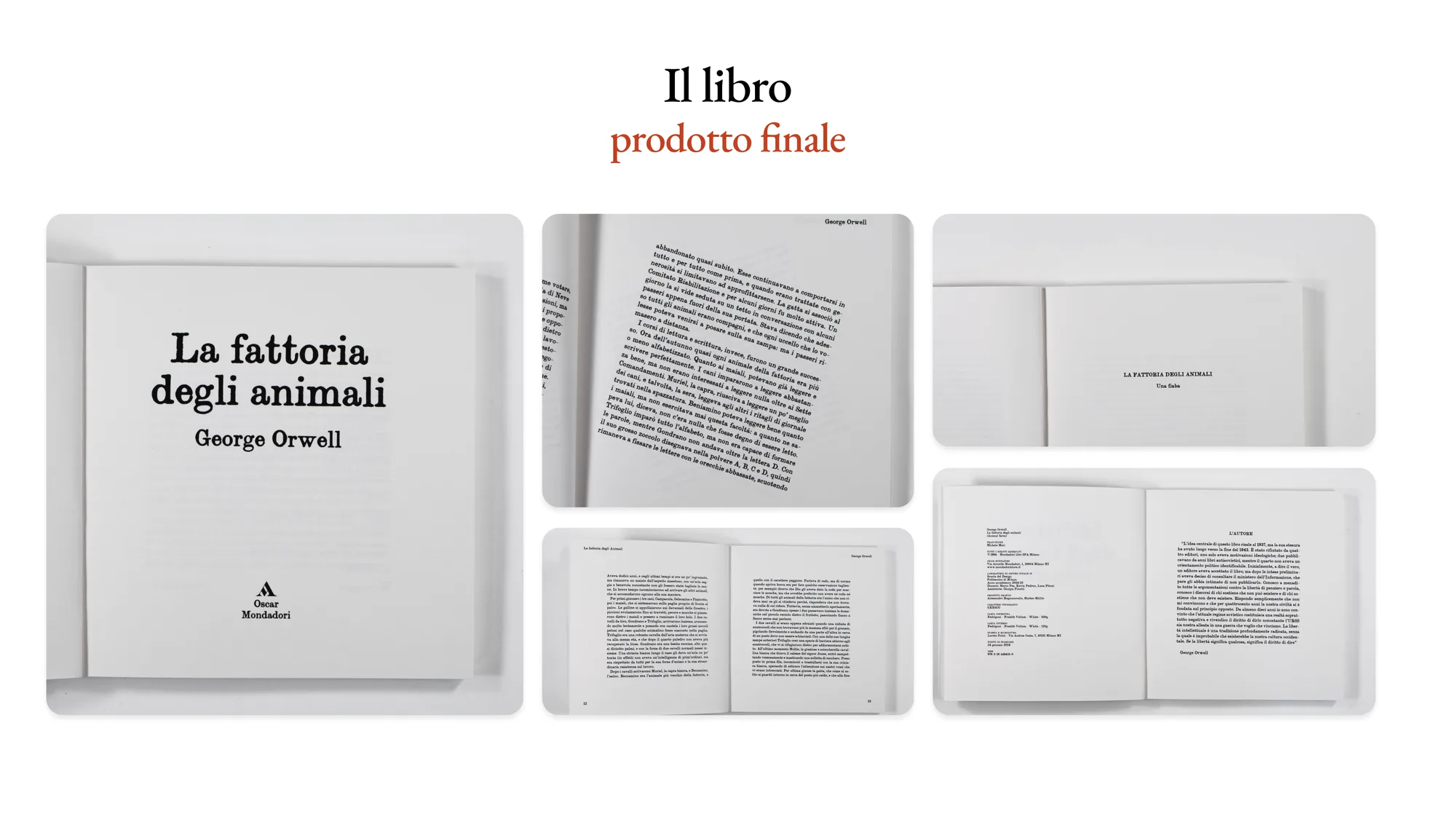
Overview For my last university project, I was asked to take a literary work and find a different way to tell its story through the design of a book. The work was picked at random from a list, and I ended up with Animal Farm by George Orwell. The challenge was to understand what the author was trying to say and find a way to express it through the book itself: its typography, layout, and materials. Orwell wasn’t exactly an easy place to start, but there was certainly plenty to explore. In the edition we designed, the text gradually rotates as the pigs consolidate their power, completing a full 360-degree turn by the end of the story, making it necessary for the reader to turn the book to keep reading. When the text returns to its original orientation, the revolution has come full circle too: the pigs have become indistinguishable from the humans they overthrew.
Thesis
University thesis
How the work began I started with Orwell himself. Before trying to give his work a new form, I wanted to understand the person who wrote it. With help from large language models, especially Claude Opus 4 , I began researching his life and the context behind Animal Farm . That meant looking into his political experiences, his criticism of totalitarianism, and the difficulties he faced in getting the book published. It also meant looking more closely at the story: how the pigs gain power, how they change the rules, and how the other animals gradually lose their ability to question what is happening around them. We also looked at how other editions had approached the same book, from simple typographic covers to Ralph Steadman’s illustrations. Alongside those, we studied books that use the page itself to tell a story. One reference was House of Leaves by Mark Z. Danielewski, where changes in the layout and direction of the text become part of the reading experience. This helped us think about what we could ask the reader to do. In Animal Farm , change happens gradually, until the animals find themselves back in a system much like the one they fought against. We translated that circular structure into the movement of the text. Turning the book became a way for the reader to take part in that movement, page after page. Working with my thesis supervisor, Kevin Maria Pedron , was what helped me most along the way. AI was useful during the research, but having someone with his knowledge and experience to discuss the project with made a real difference. Those conversations were an important part of developing the work.
A lot of help also came from my girlfriend, many thanks to her.